Blackout curtains in Dubai, made to measure
A blackout curtain is a curtain that lets no light through its cloth.
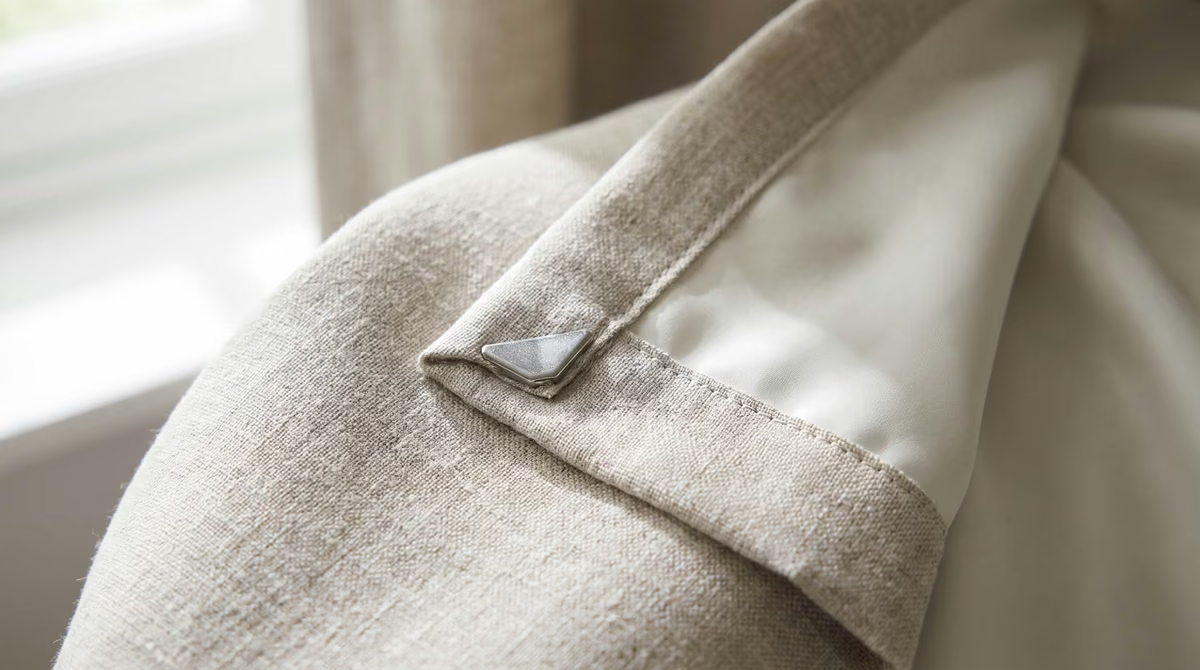
Ours get that from a four-pass silicone blackout lining sewn behind the face fabric: the lining stops the light, and the face fabric can be whatever you want the room to look like.
AED 45 per m²
with the track and the fitting included.
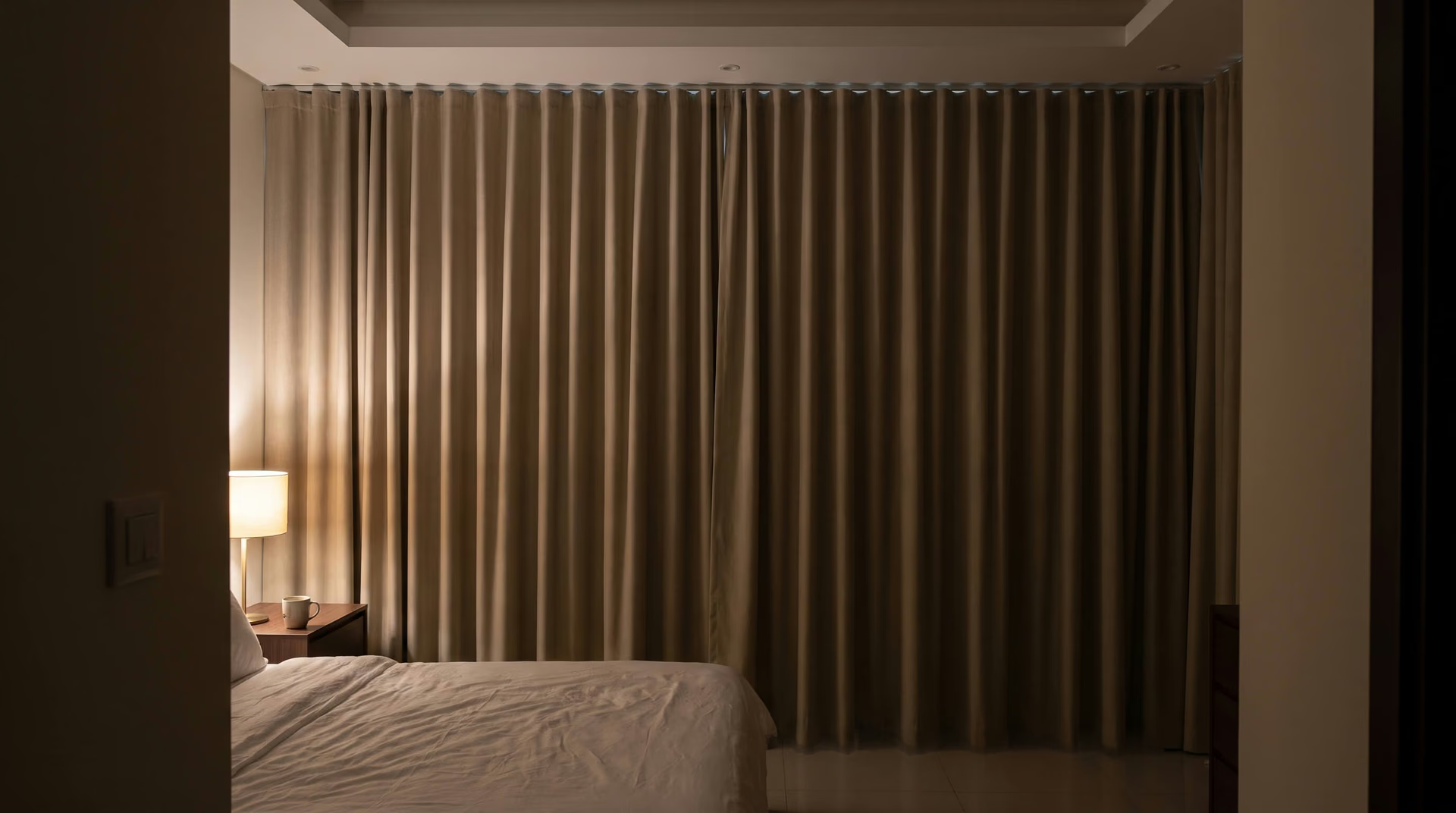
Curtains Express measures, makes and fits every pair, usually within about a week of your go-ahead, and every pair carries a two-year warranty on stitching and fitting.
Free measuring visit
There's no walk-in counter. Someone brings the fabric book and the blackout lining to your home or office, so you can hold them against your own window before anything is ordered.
Made and fitted in about a week
Measured, cut and sewn by us, and usually fitted within about a week of your go-ahead. The track and the fitting are included in the price.
Two-year warranty
Every pair is covered for two years on stitching and fitting. We made it, so an alteration or a repair later comes back to the same people.
Blackout curtains, in short
- A blackout curtain lets no light through its cloth. Curtains Express makes them with a four-pass silicone blackout lining sewn behind the face fabric.
- A lining is the most light-tight way to make a curtain blackout, and it leaves the face fabric and colour entirely your choice.
- Whether the room goes dark is decided by the fitting: a high track, running wide past the frame, overlapping at the centre, with the curtain down to the floor.
- Blackout, blockout and black-out are the same thing. Dimout is not: it still glows.
- A sheer on a double track behind it gives you daylight by day and dark at night.
- A pinch pleat or ripple fold pair can be motorized with Somfy or Dooya, on a timer if you want the morning light back.
- From AED 45 per m² with the track and fitting included, fitted in about a week, and covered for two years on stitching and fitting.
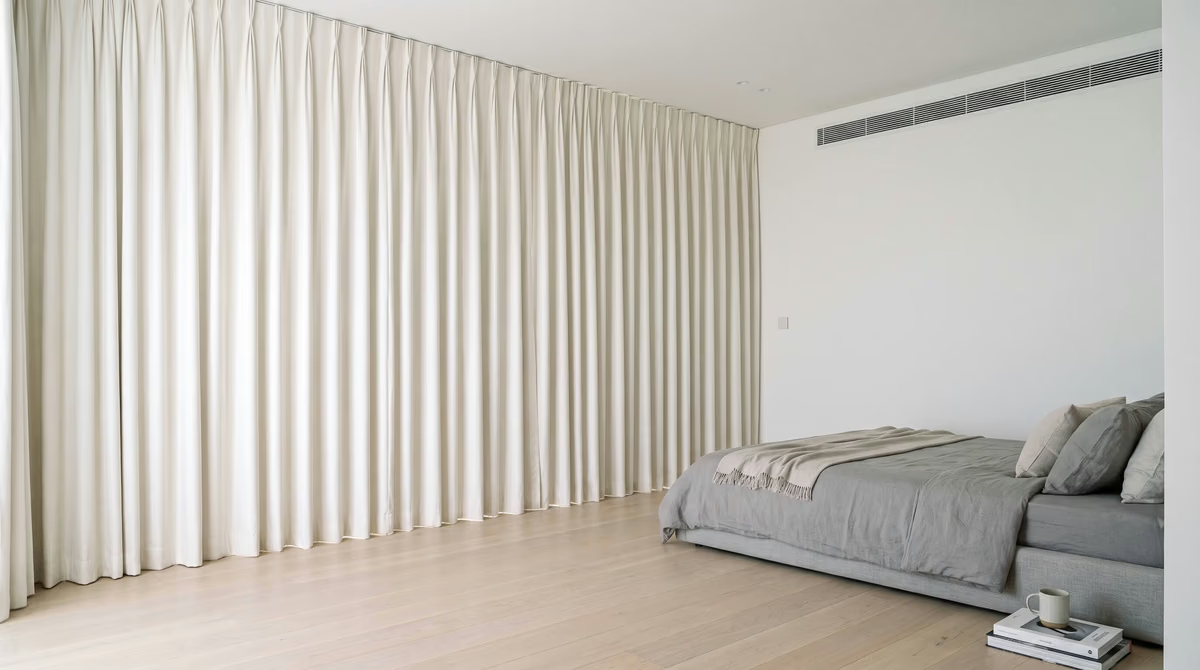
Not sure the window wants a curtain at all? A blackout blind fits inside the reveal, and a roller blind running in side channels darkens a window with no room for a curtain to stack. We will say at the visit which one suits.
What blackout curtains cost in Dubai
Blackout curtains start at AED 45 per m², and that price includes a standard track and the fitting. It is a made-to-measure pair in a standard face fabric with our four-pass lining, measured and fitted. The quote you get is for the finished window, not the fabric alone.
Price your window
- Fabric
- 200 cm × 2 (fullness) × 300 cm = 12 m²
- Rate
- AED 45 per m²
AED 540
Standard face fabric with our four-pass lining, track and fitting included. The final figure follows the free measuring visit.
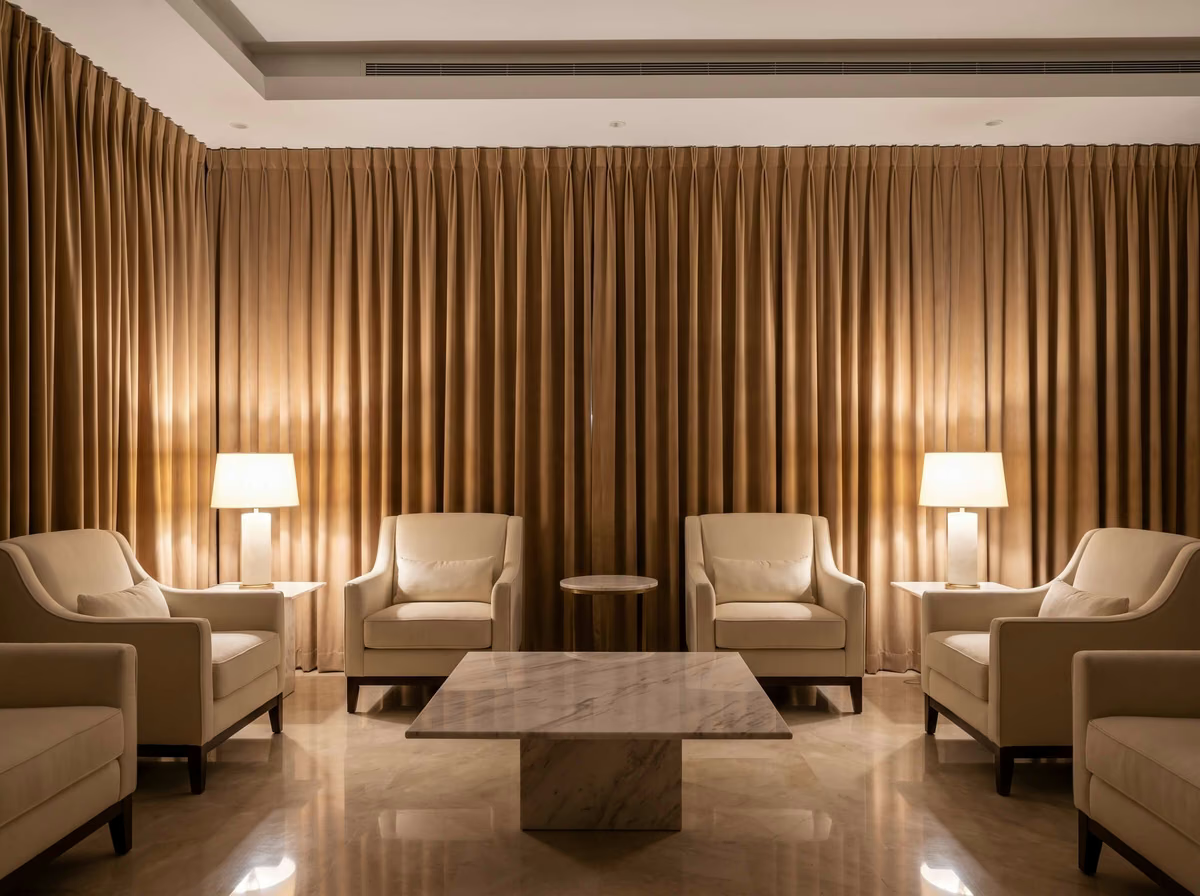
What moves the figure is the same short list every time:
- Face fabric
- A plain weave costs less than a linen, a velvet or a designer range. The four-pass lining behind it is the same on all of them.
- Fullness
- A curtain gathered to twice the width of its track uses twice the cloth of a flat one, and looks it.
- Heading
- Ripple fold runs on its own track; pinch pleat and eyelet are made and priced differently again.
- A sheer behind it
- A double track adds a second curtain and a second track.
- A motor
- Somfy or Dooya is the largest single addition, and quoted separately.
Adding a blackout lining to curtains you already own is priced on its own, and costs less than a new pair.
Measuring is free. Send the rough window sizes on WhatsApp for a first figure, and nothing is cut before you have seen the final number.
Every other rate we charge, for curtains and blinds, is on our price list.
Ready-made or made-to-measure blackout curtains?
If what you want is the cheapest blackout curtain in Dubai, it is a ready-made panel from a homeware store, and on a small, standard window that is the right answer. We would rather say so than pretend otherwise. Made to measure is closer than most people expect, though: ours start at AED 45 per m², with the track and the fitting included.
Ready-made falls short in three places:
Length
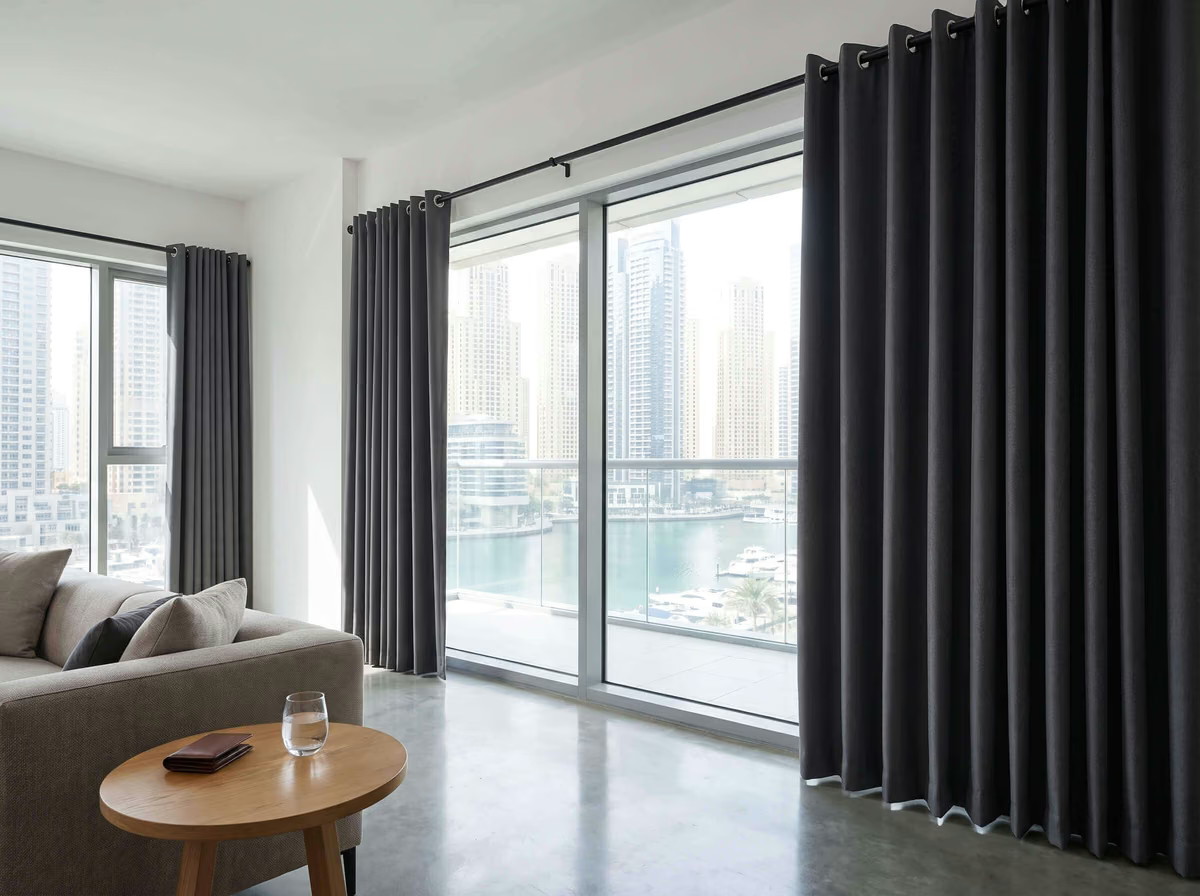
Stock panels come in a few fixed drops, and floor-to-ceiling glass in a Dubai tower often runs longer than any of them. That is why so many people search for 300 cm blackout curtains. A short one leaks light under the hem.
Width
Two stock panels rarely cover a wide window with the overlap at the sides that keeps light from creeping round the edges.
Fixing
A lined blackout pair is heavy. Hung from a gypsum bulkhead or into a concrete ceiling, it needs a fixing that reaches something solid, not the rod that came in the box.
Made to measure means the curtain is cut to your drop and your track, gathered to the right fullness, lined, and fitted by the people who made it.
A four-pass silicone lining, and why it blocks the most light
There are three ways to make a curtain blackout, and they do not perform the same.
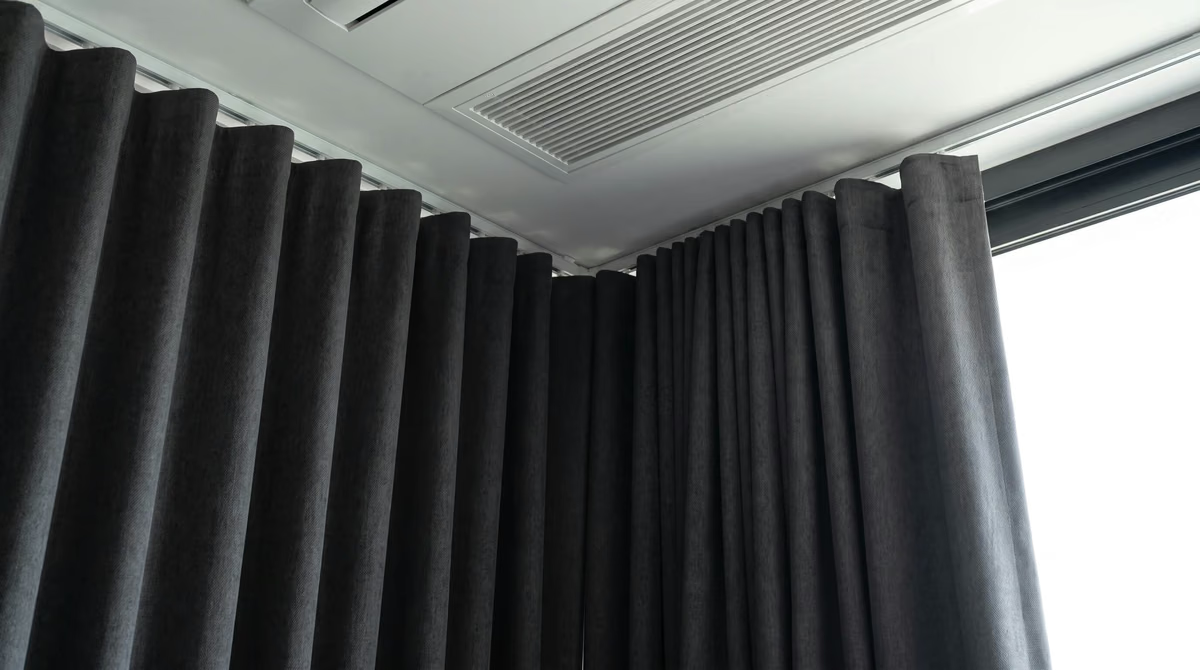
How to tell, and what to call it
Hold any fabric against a phone torch. Blackout shows nothing through it; dimout glows. Blackout, blockout and black-out are the same thing under three spellings, and American shops sell them as blackout drapes.
Already have curtains you like? We can sew the same blackout lining onto them rather than making a new pair.
Where the light gets in, and how the fitting stops it
Whether the room actually goes dark is decided by the fitting, because daylight gets in around a blackout curtain rather than through it.
So the track runs wider than the glass, the pair overlaps where it meets, and the curtain finishes at the floor. On an east-facing bedroom in Dubai, where the sun is up before half past five in June, that detail is the whole job.
Blackout fabric stops light passing through the cloth. It does nothing about the gaps around the curtain, and a pair hung the ordinary way leaves four of them.
Which curtain heading gets a room darkest
The heading is how the top of a curtain is made and hung. For blackout it matters more than it looks, because it decides whether light gets in over the top.
Blackout, dimout and sheer curtains, side by side
Three kinds of curtain get mentioned in the same breath and do very different jobs. Here is what each does with daylight, and with your privacy once the lights are on.
| Blackout | Dimout | Sheer | |
|---|---|---|---|
| Light through the cloth | None | Heavily cut; the cloth glows | Soft and filtered |
| See out by day | No | No | Yes, softly |
| Privacy at night | Full | Full | Very little |
| How it hangs | Full, weighted folds | Soft folds | Light; moves with air |
| Suits | Bedrooms, nurseries, TV rooms | Living and guest rooms | Glass you want to keep open |
Blackout here means our standard build: a face fabric with a four-pass silicone blackout lining behind it. A dimout, sometimes sold as room-darkening, is a dense fabric without that lining, which is why it still glows when the sun is on it.
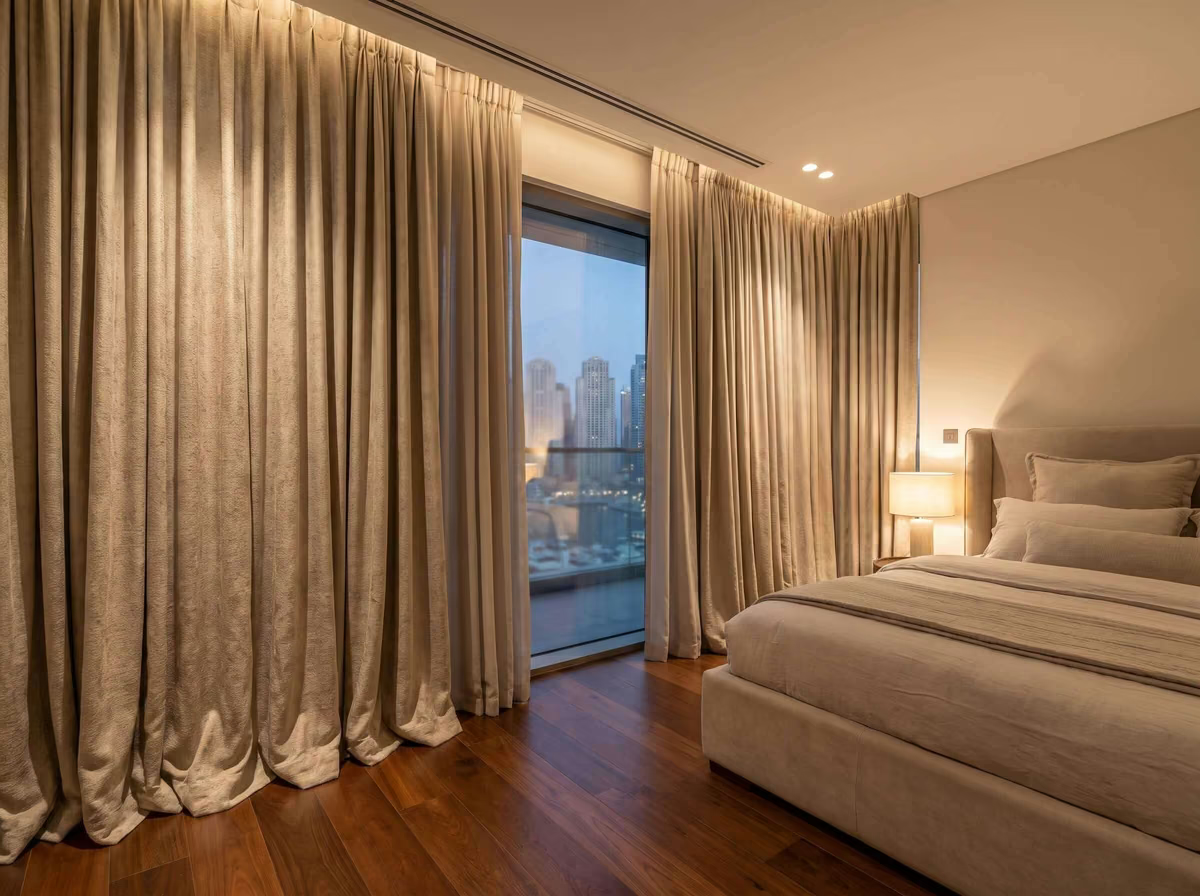
Sheer and blackout curtains on one double track
Most rooms here end up with two curtains rather than one: a sheer on the track nearest the glass for the day, and the blackout pair on the track in front of it for the night.
By day the sheer takes the glare off the glass and keeps the room private from the building opposite, while the blackout stacks back at the sides. At night, or for an afternoon sleep, the blackout closes over it. One double track carries both, fixed into the same ceiling or pocket, so there is still nothing showing above the curtains.
It is the way to have a room that works in daylight and goes dark on demand, and it is what we suggest for most bedrooms and living rooms in Dubai apartments. Our sheer curtains are the other half of the pair.
Motorized blackout curtains, with Somfy or Dooya
A lined blackout pair is heavy, and on a wide window or a double track it is the curtain people most often wish they did not have to pull by hand. Any pinch pleat or ripple fold blackout curtain we make can run on a motorized track instead.
Somfy or Dooya
We install both. Somfy is the French system most often specified for villas and smart homes, and the one to choose if the curtains have to join a wider home automation setup. Dooya does the same job on a single room or a small run for less. Both work from a remote or a wall switch, both can be grouped so one button moves a whole room, and a double track can carry two motors so the sheer and the blackout move on their own. Somfy motors carry a five-year warranty and Dooya motors two; the two are compared side by side on our motorized curtains page.
A timer that lets the morning in
A motor also answers the one fair objection to blackout: that a room too dark to wake up in is hard to get up from. Set the curtains to open at the time your alarm goes off, and the daylight does the waking.
Power at the window
A wired motor needs a power point inside the curtain pocket, at the end where the motor sits, which is simplest to arrange before a ceiling is closed up, so raise it at the measuring visit. A battery motor needs no wiring at all.
Book a free measuring visit
Tell us which rooms and roughly how many windows. Someone brings the fabric book and the blackout lining to you, anywhere across Dubai.
Blackout curtains for bedrooms, nurseries and day sleepers
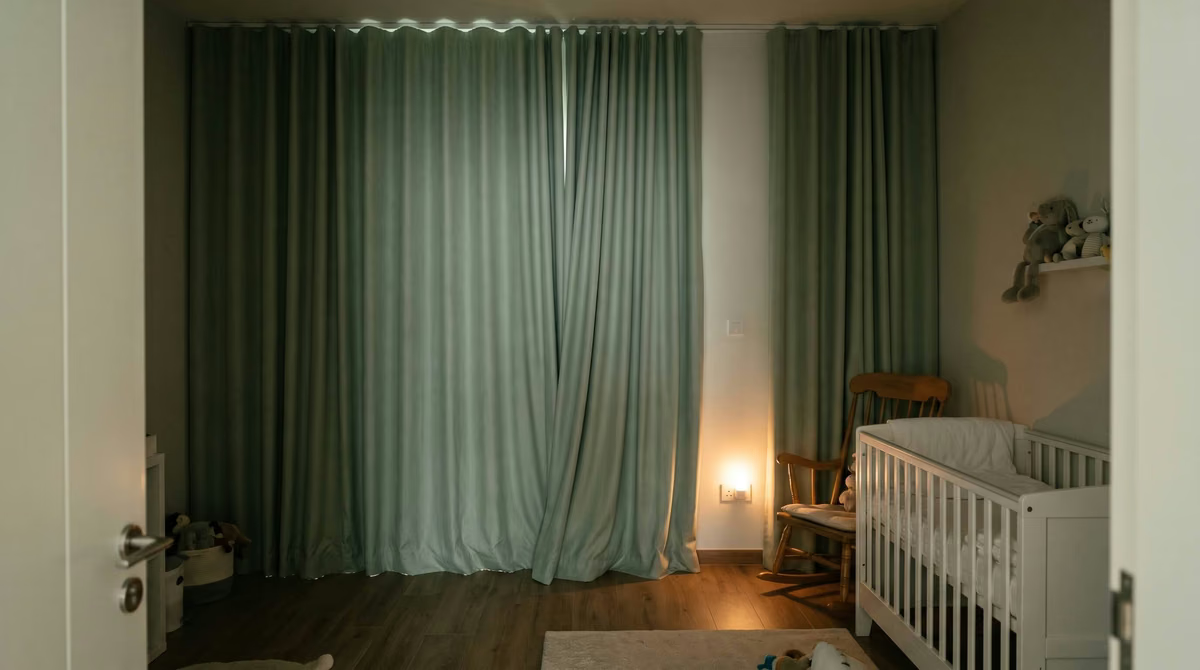
East-facing bedrooms
In June the sun is up in Dubai before half past five, and an east-facing bedroom takes it straight through the glass. It is the classic case for blackout, and the fitting matters more here than anywhere else. There is more on the rest of the room in bedroom curtains.
Nurseries and children's rooms
A room that has to go dark for a daytime nap has to go properly dark, and a strip of light over the track is enough to undo it. In a child's room we also fit any pull cord well out of reach.
Day sleepers
Cabin crew, hospital staff and anyone on nights sleep while the city is at its brightest. For them blackout is not a preference, and it is worth doing on every window in the bedroom, not only the big one.
TV rooms and home offices
West-facing glass in the afternoon puts glare straight onto a television or a monitor. Here a blackout pair solves a glare problem rather than a sleep problem, and in a living room it usually shares a double track with a sheer for the rest of the day.
Heat, glare and fading in a Dubai summer
On a summer afternoon the glass is the hottest surface in the room. What blackout curtains do about that, and what they don't:
Heat
Drawn across the glass with the lining facing the window, a blackout pair turns a good part of the sun back before it reaches the room, so the room stays cooler and the air conditioning has less to do. On west-facing glass in July the difference is easy to feel. It is shade rather than insulation, though. If keeping heat out is the main goal, honeycomb blinds trap still air against the glass and do more.
Fading
Drawn during the hours the sun is on the window, blackout keeps it off sofas, rugs and wooden floors, which fade faster in this light than most people expect.
Noise
A heavy lined pair softens echo in the room and takes the edge off street noise, but it is not soundproofing. Noise comes through the glass and the frame, and that is where it gets solved.
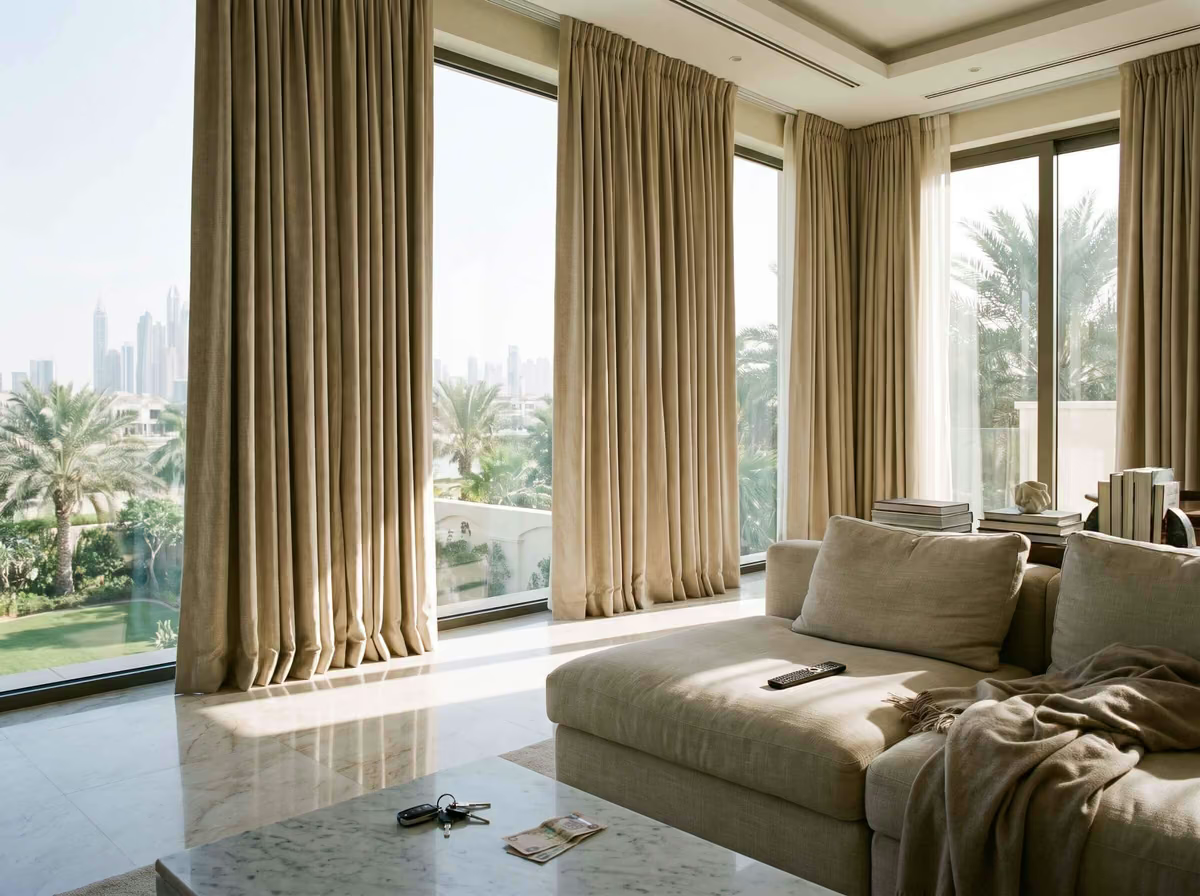
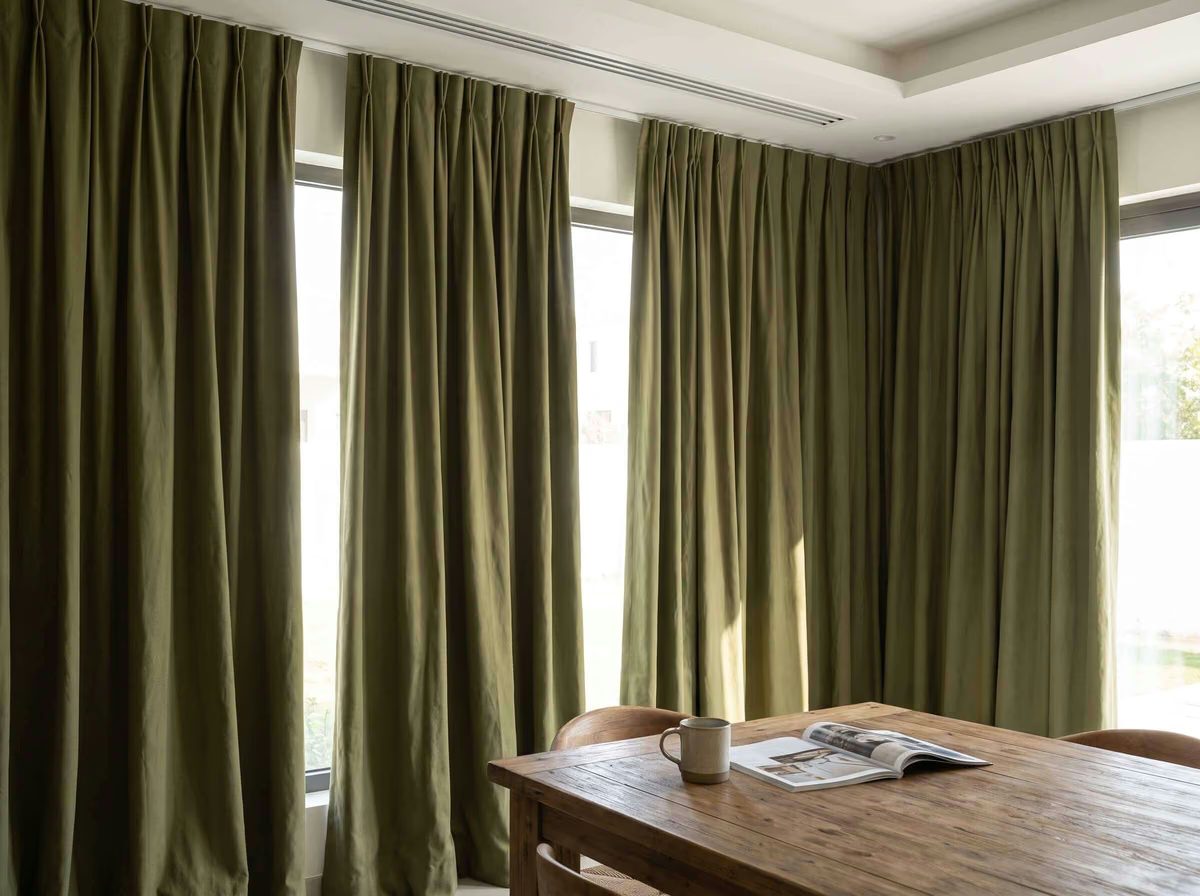
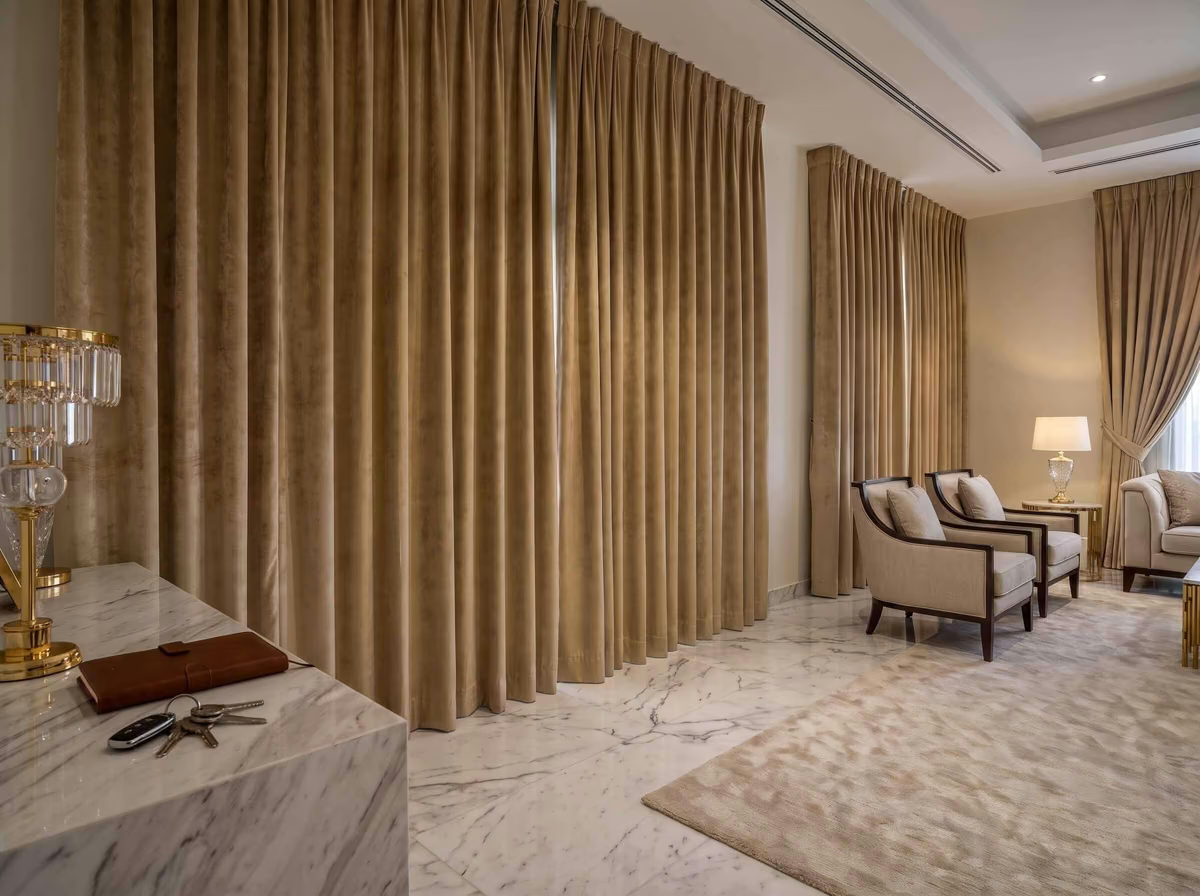
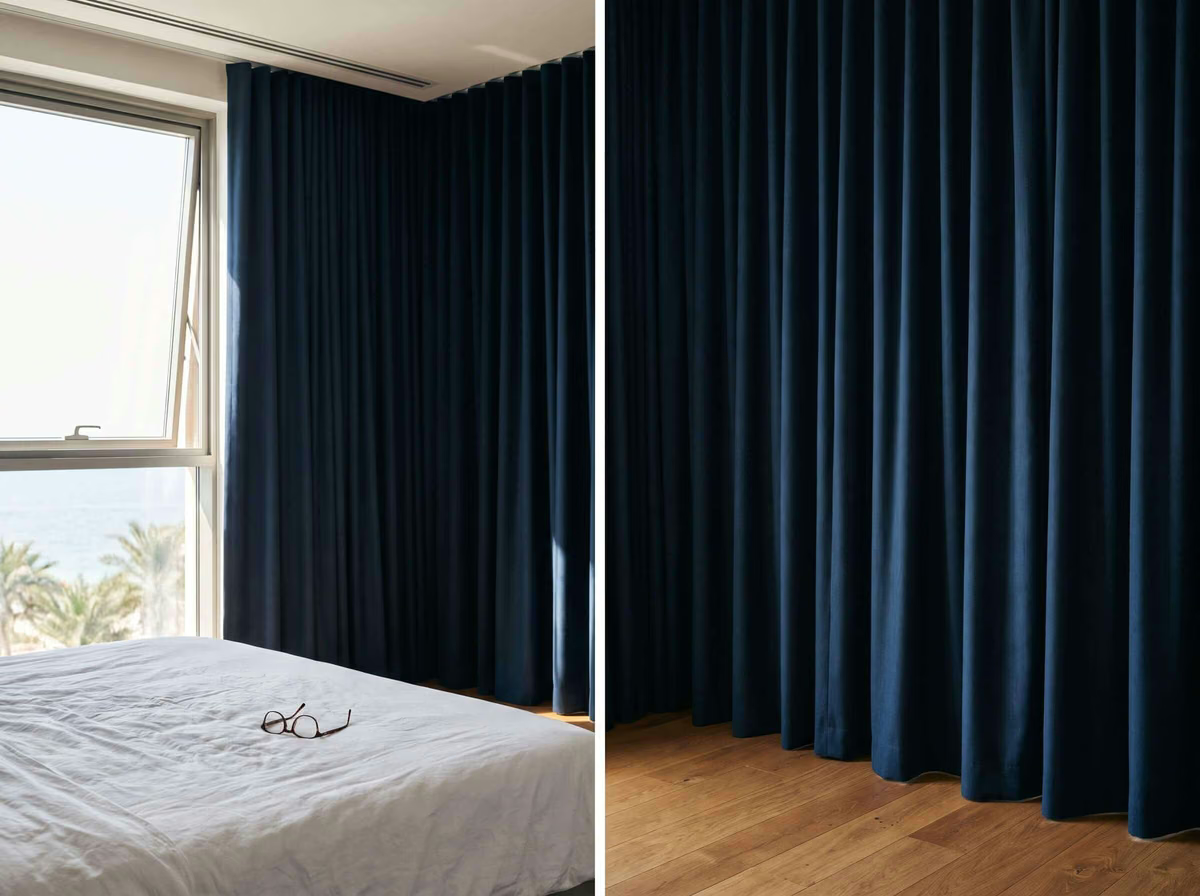
Blackout curtains in different styles
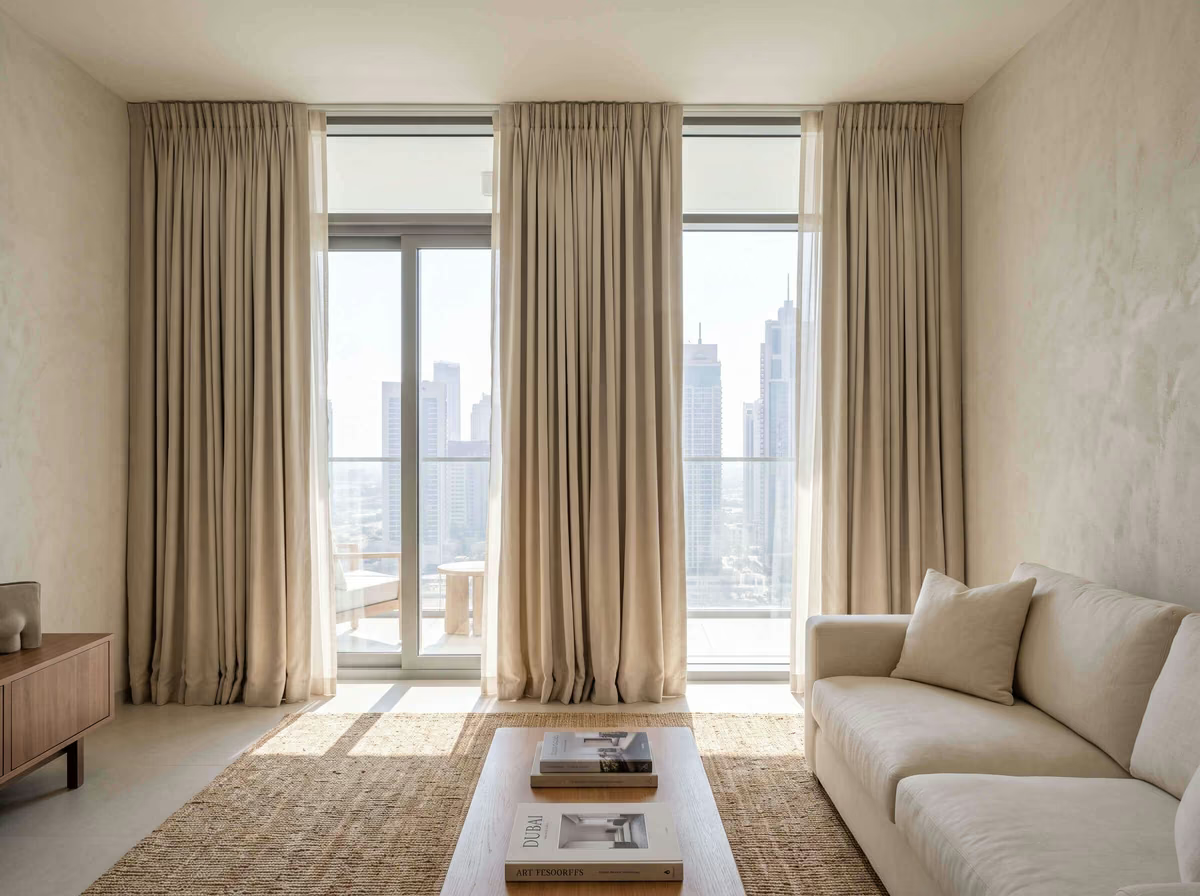
Blackout curtains: common questions
How much do blackout curtains cost in Dubai?
Ours start at AED 45 per m², and that includes a standard track and the fitting, so the figure is for the finished window. What moves it is the face fabric, how full the curtain is gathered, the heading, whether a sheer goes behind it on a double track, and whether it is motorized.
Measuring is free. Send the rough window sizes on WhatsApp and we will come back with a real figure rather than a range.
Do blackout curtains block out all light?
The fabric does: a curtain with a four-pass blackout lining lets no light through the cloth. The room is another matter, because daylight gets in around a curtain, over the top of the track, down the sides, through the centre where the pair meets and under the hem.
For a properly dark room the track goes high and runs at least 15 to 20 cm past the frame on each side, the pair overlaps at the centre, and the curtain runs to the floor.
What is the difference between blackout and dimout curtains?
A blackout curtain lets no light through the cloth. A dimout, sometimes sold as room-darkening, cuts the light heavily but still glows when the sun is on it, because it is a dense fabric with no blackout lining.
Dimout suits living and guest rooms where you want the glare gone but not the daylight. Anywhere you need to sleep while it is light outside, choose blackout.
Are blackout and blockout curtains the same thing?
Yes. Blackout, blockout and black-out are three spellings of the same thing, and American shops call them blackout drapes. What matters is whether the cloth passes light, which you can check by holding it against a phone torch.
Do blackout curtains keep a room cooler?
Yes, while the sun is on the window. Drawn across hot glass with the lining facing out, a blackout curtain turns a good part of the sun back before it reaches the room, so the room stays cooler and the air conditioning has less to do.
It is shade rather than insulation, though. If keeping heat out is the main aim, a honeycomb blind, which traps still air against the glass, does more.
Are blackout curtains soundproof?
No. A heavy lined pair softens echo inside the room and takes the edge off street noise, but most noise comes through the glass and the frame, and no curtain stops that.
Can you add a blackout lining to my existing curtains?
Yes. If you like the curtains you have, we can sew the same four-pass silicone blackout lining onto the back of them instead of making a new pair. We check the track at the same time, because the lining adds weight, and a fixing that held an unlined curtain may not hold a lined one.
How do you clean blackout curtains?
Vacuum them every few weeks on a low setting with a brush attachment, which keeps most of the dust off. For a proper clean, follow the face fabric's care label: the lining itself takes dry cleaning or a cool, gentle wash, but never a tumble dryer, and never an iron on the lining side.
Should I choose blackout curtains or blackout blinds?
On a large window a curtain makes a room darker, because it can overlap the wall on every side. A blind sits in or just outside the frame, and leaves a line of light at its edges unless it runs in side channels. A blind wins on a small window, in a tight recess, or where there is no room for a curtain to stack back.
Many bedrooms have both: a blackout blind in the reveal and a curtain in front of it for the look.
Can blackout curtains be motorized?
Yes, in pinch pleat or ripple fold; an eyelet curtain slides on a pole and can't take a motor. Any pinch pleat or ripple fold blackout curtain we make can run on a motorized track, and we install both Somfy and Dooya motors. Somfy is the one to choose if the curtains are joining a wider smart-home system; Dooya does the same job on a room or two for less. Both run from a remote or a wall switch, and a double track can carry two motors so the sheer and the blackout move separately.
A wired motor needs a power point inside the curtain pocket at the motor end, so raise it at the measuring visit, before anything is installed. A battery motor needs no wiring.
How long does it take, and is there a warranty?
Usually about a week from your go-ahead to the curtains being fitted, after a free measuring visit. Every pair carries a two-year warranty on stitching and fitting, and because we make the curtains ourselves, alterations and repairs afterwards come back to the same people.
Tell us about the window
Call or WhatsApp +971 50 280 8765 with the room, the rough width and which way the glass faces, and we will tell you what it takes to make it dark.