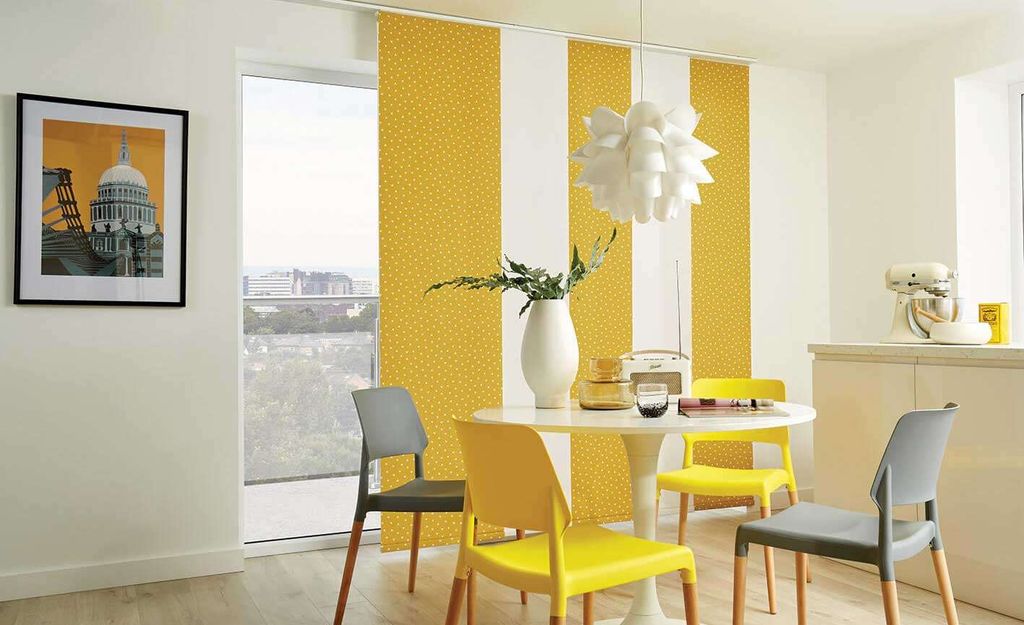
Panel blinds, made to measure in Dubai
A panel blind is a set of wide flat fabric panels hung from a headrail with several tracks in it. Each panel slides on its own track, so they pass behind one another and park at one end of the run, or split and park at both ends to clear the middle of the glass.
It suits the openings that curtains and small blinds handle badly: a balcony slider, a wide living-room span, a bedroom that has been divided, or a gap between two rooms that needs closing without building a door.
Stacks to one side
The panels slide behind one another and park at one end, or split and park at both, so the glass is clear when they're open.
Works as a divider
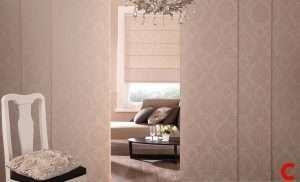
The same track hung across the middle of a room closes off a study area or a bed without putting up a wall.
Free measuring visit
Someone measures the run, checks what the track can fix into, and works out how far past the opening it has to reach.
Where the stack goes decides the track
Open a panel blind and the panels don't disappear anywhere — they slide behind one another and sit somewhere. If the track stops at the edge of the opening, that stack sits over the glass, and you lose a slice of the view and a slice of the light with it.
So the track usually runs past the opening at one end or both, onto the wall beside it. Where there's no wall to run onto, the answer is more channels in the headrail: the more tracks there are, the tighter the panels stack behind each other and the less glass they cover.
That's the measurement that matters most on this product, and it's the one that's awkward to change once the track is up. It gets worked out on the measuring visit, with the opening in front of us.
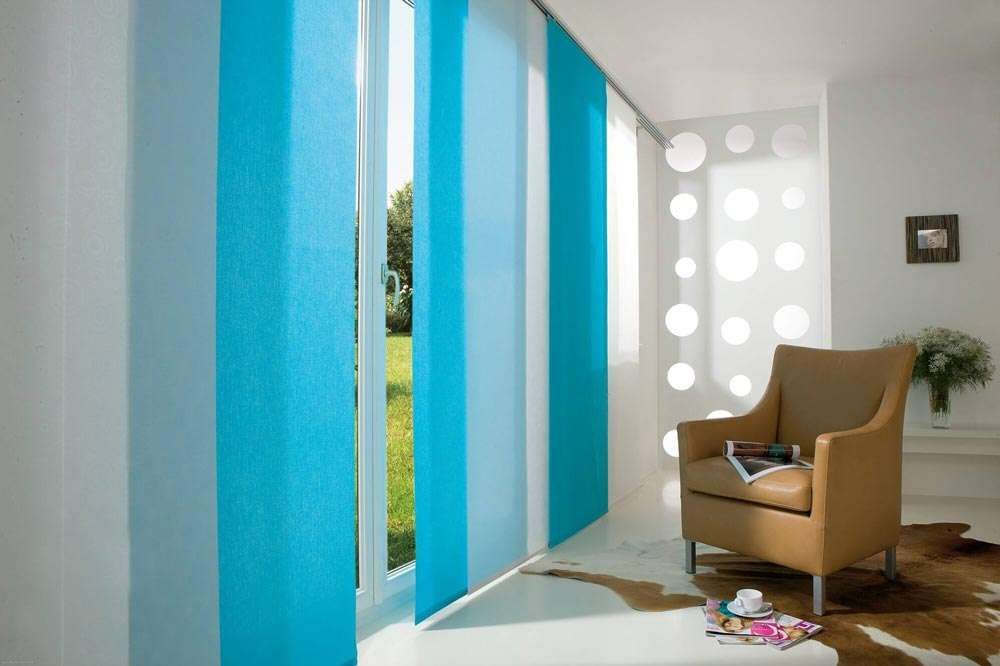
Book a free measuring visit
Tell us your area and what you're covering — a balcony slider, a wide window, a room that needs dividing — and we'll bring the range to you.
Fabric decides what you keep of the view
Panels take the same broad fabric families as roller blinds, and the choice does more to a room than the colour does.
Sunscreen is an open weave. It cuts glare and heat off west-facing glass while you can still see out through it in daylight, which is the point on a balcony you actually look out of. After dark it works the other way round: with the lights on inside, an open weave shows a silhouette.
Dimout is a solid cloth that takes the light right down without claiming to remove it. Blackout fabric stops light passing through the cloth altogether.
Worth being plain about the limit: on any sliding system some light still comes in at the edges and between the panels. A panel blind is light control, not a light seal. Where a room has to be properly dark, it goes behind a curtain that overlaps the frame.
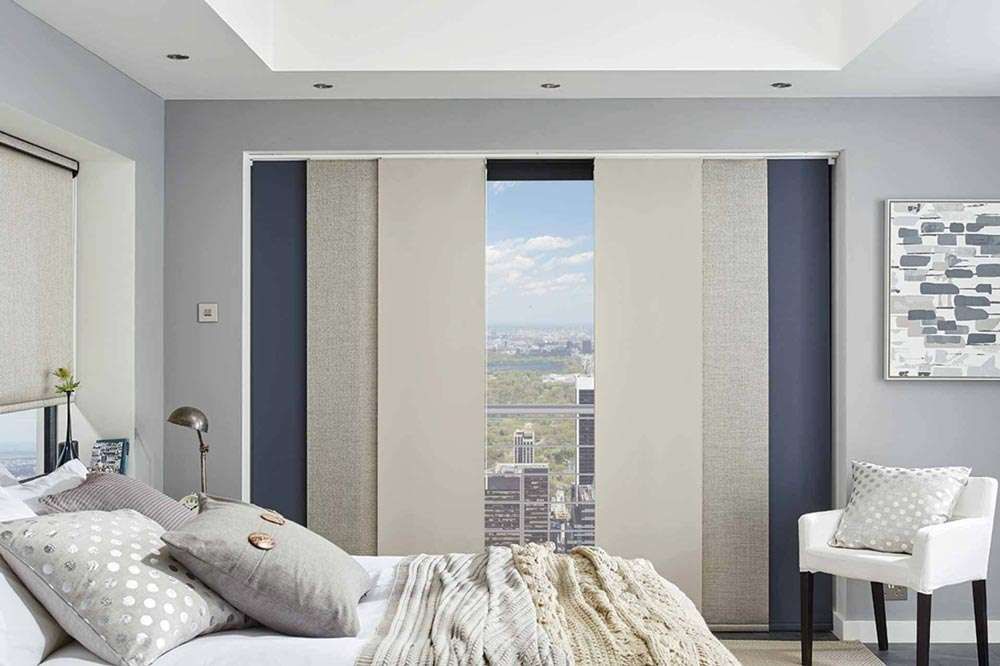
Panel blinds in use
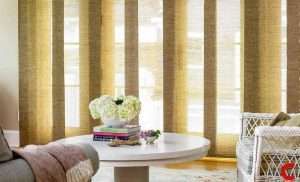
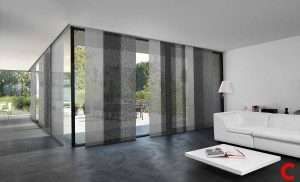
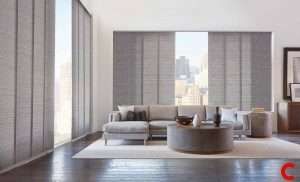
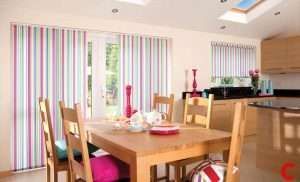
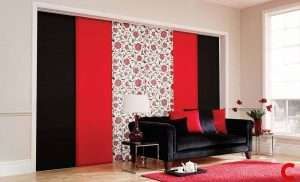
Panel blinds against vertical blinds
Panel blinds came out of vertical blinds and answer the same problem: a wide opening that has to be covered by something moving sideways. The difference is how many pieces are doing it.
A vertical blind is dozens of narrow vanes hanging from a track. They tilt, which panels don't, but they also move in a draught, catch when a door swings past, and end up hanging unevenly. A panel blind is a handful of wide flat sheets, so the run reads as one plane and there are fewer pieces to go out of line on a track that gets used every day.
What you give up is the tilt. If the point is to keep the glass covered and still let daylight in at an angle, that's a vertical or a venetian, not a panel.
The flat panels do make the dust easier. There's one surface per panel rather than a hundred narrow edges, so they take a wipe or a vacuum brush — which counts on a window that faces a road or a building site.
Get a quote for your windows
Call or WhatsApp us and we'll arrange a time to measure the opening and price the job before anything is cut.